
Having the Courage to Trust What God is Asking of You, by Guest Lecturer Joshua Inacio

from August 24th, 2026
We welcome you to watch/listen to the video, read the transcript below, and/or share your thoughts in the comments!
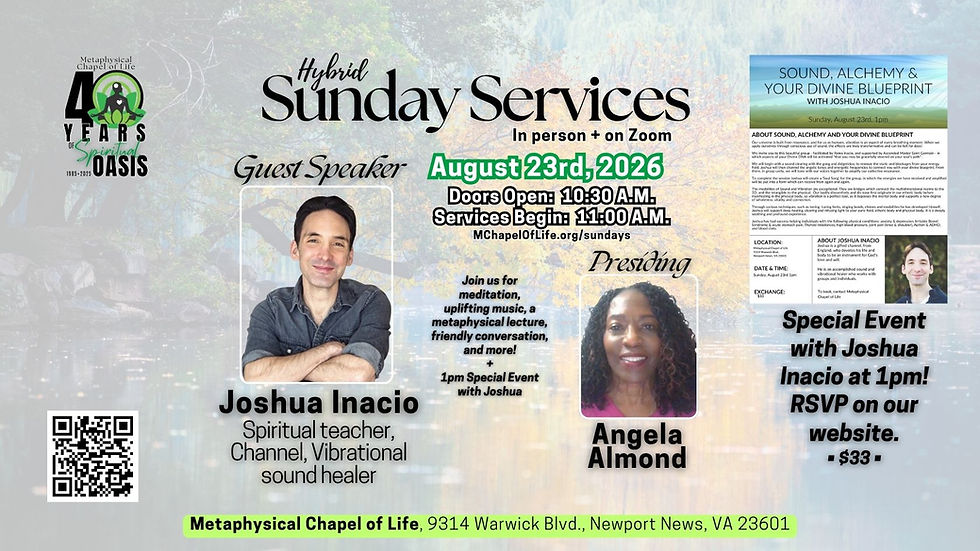
About the Lecturer
Joshua Inacio is a spiritual teacher, channel, and vibrational sound healer with over 20 years of metaphysical experience. Originally from England, Joshua relocated to the USA in 2010 and now lives with his three children in beautiful Virginia. Joshua divides his time between visiting communities around the country and doing his holistic work locally, which includes regular groups for channeling, sound healing, and spiritual teaching. This year Joshua will be giving retreats and traveling, including gatherings in the Mid West, South West, East Coast and Great Lakes region. In 2025 he led gatherings in Ireland, Mexico and the UK.
He hosts HomeLight, an online membership community offering live channeling, sound healing, and teaching for those committed to their spiritual growth. He is also the founder of The Light of Home, a Virginia nonprofit dedicated to making healing services accessible to those who need them most. Joshua is currently writing a book on developing a relationship with our energy anatomy as it relates to all of our human experiences, and continually creates sound and vibrational works for the betterment of wellbeing.
As a holistic practitioner, Joshua supports people navigating a wide range of experiences, including anxiety and depression, sleep disorders, addiction, autoimmune challenges, digestive issues, infertility, autism, and the feeling of being energetically stuck.
His deepest interests lie in deepening our connection to the divine, building community, and supporting people in understanding their own healing — through developing intuition, cultivating prosperity, and working across modalities to meet people wherever they are.
Having the Courage to Trust What God Is Asking of You Guest Lecture by Joshua Inacio — Sunday, August 23, 2026
A very good morning to you all. Thank you all so very much for having me. It's a real pleasure and a privilege and an honor to be here. And for you all on Zoom as well — this is like Live Aid, isn't it? Good morning, Philadelphia.
The music today was beautiful, thank you so very much, Delight and Angela. If Angela asked me to do anything, I would do it. Reggie, I don't know how you get anything done, quite honestly. When she invited me — back in April, actually, quite a while ago — it was instantly, instantly, yes. And Stanley, thank you for all your support as well.
That was a pretty lengthy introduction, not used to hearing that either, so let me get straight on.
Speaking to the Individual
When I have the opportunity to speak on occasions such as this, in the past I have done my best to speak to current world events and the state of where we are, because we're all living the same thing. I have been doing this work for a while, and there'll be times when something massive and huge will happen on a Saturday night, and I think, oh God, I've got to stand in front of people and say something about that.
It's been a long couple of years. And I feel we've all gotten somewhat normalized, desensitized to the massive occasions happening, it seems daily in the world.
And so my feeling, leading up to today, is actually not to speak to the greater, but to speak to the individual, and to honor each person's journey. That's where I want to go, because I think everything converges there anyway.
My job today is to remind and reassure you all that you are on track. I do believe that, but sometimes we don't feel that.
So the title of the talk that I failed to give today is, Having the Courage to Trust What God Is Asking of You. There are three components of that: there is trust, there is courage, and there is what God is asking of you.
The Real World Challenge
The real world challenge — I don't like the expression "real world," but physical world, daily world, right? The real world challenge: I don't believe anyone is lost or ungodly. I don't believe that. I believe a lot of people are overwhelmed, though. The constant information. The instability, continual pressure, and exhaustion. That's just one day.
I think the real question that a lot of people ask is, how do I even know what to do anymore? And when we're continually questioning everything — leadership, institutions, artificial intelligence and deepfakes — and, most of all, our own judgment — if there is a spiritual crisis or an existential crisis, it is internal confusion. It's not belief.
And so, if trusting God feels harder at this time of our lives than it has before, I don't think it's because we've lost faith in God. I think it's because we've lost confidence in recognizing how God works.
How God Communicates
What is involved with how God communicates with us? Some of you have read the Bible, some of you have read the Quran, the Talmud, the Tao. And the trouble is, all of these wonderful books lead us to expect loud things. It's always angels on fire, people coming down mountains carrying stuff, often on fire. But my point is, we expect things to be loud, certain, clear. Or blissful, right?
Whereas actually, the guidance that most of us get — how God speaks to most of us — is kind of boring. Right? Inconvenient, personal. And, worst of all, persistent.
We have an expression for that, don't we? We say, conscience is a pest. You ever heard that? Conscience is a pest. When you know something to be true, and you do your best and put a huge amount of energy into avoiding that truth, but it won't leave you alone, like a mosquito in a car.
And we can have absence of peace in a life that looks otherwise fantastic. But our relationship with our conscience is unavoidable. For the best reason.
The crux is, we expect certainty, but what we get is accountability. I don't think we're waiting on guidance. I think we're waiting on giving ourselves permission.
Angela was sharing with me that part of today's, and the regular service, is to share messages. And I really wonder — if we had this conversation, how many people are just going through a journey to give themselves the necessary permission to do what they want to do.
What is divine guidance trying to show us? What is God trying to say to us? It's often going to be: is there a boundary that we have to set somewhere? Is there a conversation we need to have? Is there a role that we have outgrown? Is there a step that we keep postponing?
And so we pray, don't we? We pray. Do you know where that prayer is coming from? In us. We're praying for clarity, but we probably already have it. And are we praying for guidance, or are we praying for God to make us not have to do the thing we know we have to do?
And so, yes, we delay, we procrastinate, and it isn't, as I keep saying, from lack of faith — it's from the fear of knowing what obedience is going to require from us.
And I think that's why community is so important. We get together and we diffuse energy together. We have conversations which may seem so meaningless, so trivial, but they're so very important, because they allow each other to be seen. We allow ourselves to be seen in the eyes of one another. And we acknowledge we have the vibrational — we give each other vibrational permission to be who we are. And wonderful things happen.
Trust
So let's talk about trust. Oh, I wish trust looked like calmness. I wish it looked like certainty, and I wish it looked like immediacy. I wish we didn't have to wait to trust. I wish we could have the confirmation like that. It pretty much never happens, as you all know.
In reality, trust, in our daily life, will look like acting when we are unsure. Or moving without a guarantee. Or honoring a truth — ours or someone else's — without comfort.
Trust and faith are usually talked about in the same conversation, aren't they? I don't think they're the same thing. Faith, I believe, is about behavior, rather than belief. I would say faith is what you do with what you know.
Courage
So if we've talked about trust, let me now speak to courage. Where does courage come into this? Well, there is a cost to following guidance, isn't there? It's going to be approval, or control, or identity, or predictability. We will lose one of those things where we follow courage.
We're not ignoring guidance because we don't hear it. We're ignoring guidance because we know the consequences of it. And courage is how you come to terms with what it is you have to do.
I'm not going to quote much Scripture today, but I'll go here, actually, from the Book of Urantia, if any of you have ever come across it. There's a lovely story about a figure in the Bible called Melchizedek, who is only mentioned twice in the Bible, which is ridiculous, because he's a very influential figure. But so the story goes: Melchizedek was a powerful leader of tribes and cities, and oversaw tens of thousands of people and vast regions. And so came the time that he was going to hand over — he was going to pass the baton to Abraham.
And so the story goes: on knowing this, Abraham was tremendously nervous, and timid, and didn't believe he was up to the job. Now, I find this quite funny. Because Abraham is the father, the godfather of religion. We wouldn't be in the room if it weren't for Abraham. If it were me taking on the mantle from someone, I think we'd all understand me being nervous, me not feeling up to it. But this is Abraham. About to kill his firstborn, Abraham. That guy.
If someone like that feels timidity, based on what lies ahead of him, comparing himself to what he believes he's capable of, I think it's okay that the rest of us do as well.
Discernment
If we're having a conversation about guidance, let's talk about discernment. How do you discern? How do you navigate? I really think discernment is one of the most important spiritual tools that there is. We're all afraid of the same kind of thing: what if I'm wrong? What if I ruin my life? What if I hurt someone? What if I lose stability? We're all afraid of the same kind of things, aren't we?
Guidance may get our attention through panic and worry. But we don't get steered that way. Anxiety shouts, but guidance persists.
We will get the next step, but we won't get the full map — and that's important, because if you look back on the last 10, 20, 30, 40 years — if you had known what was coming, would you have done it? Would you have hid under the bed? I probably would. I lived in three different countries in a year once. I remember sitting at a table, and a teeny, teeny voice says, in a year, you will be married with a child on the way. I was currently single at the time. And it was true. It happened. It happened.
And the changes that get made in our lives — I say "get made" like we don't have something to do with it, but you know what I mean — we deal with it, don't we? We're very adaptable spirits in the human body. But we'll only get the next step because that's what we can integrate. I want to know what's going to happen in my life as much as anyone else does, but I know I couldn't handle knowing that.
Going deeper — how can you tell the difference? We can trust our guidance when we know that ultimately it points towards honesty, and aliveness, and integrity, or growth, or love. We know that. I don't think we can trust our guidance when it points us towards impulsivity, or people-pleasing, or avoidance. Divine guidance is going to point us towards truth, and not escapism.
A Story from the Shower
About that small voice, the small voice that we all have, which is not coming from pressure, or egoism, or panic, but is always there — I'll tell you a quick story, if I may. It was a few Sundays ago. I woke up feeling not good. Gripped by agitation, anxiety, just under that cloud. I went and had a shower. And the water is pounding against my face, and in your ear, and up your nose, and so on. And I said, God, help me.
Water going in my eyes and everything. And God says: why? The shower's working fine. I said, no, I said, help me. What do you need? comes the answer. And I thought, I don't know. That's interesting. I don't know. That's not true. Of course I knew. I just hadn't sat long enough to get clear about the question I had in the first place. That was the first thing I learned that morning.
The second thing I learned that morning is that something inside my head thinks God lives in the shower. As far as I've been told, God is pretty much anywhere that you can look. So I should stop waiting for that.
It's the courage to trust God. It's actually trusting that God is closer to your life than fear is. God is closer to your life than fear is. I've had to say those words to myself a couple of times today, actually, for my own reason.
And following that — as I say, it's not dramatic. When it comes to the moment where you can accept, it's very still, isn't it? Very quiet, there's no emotions, it's boring. It's where we end pretense. Or we say no, or we have the conversation. And the reward for that — because if there's a cost, well, there's a reward — the reward is peace. Do you know peace? Do you know that thing we all want? Peace. And knowing.
Courage, Revisited
So let's just one more time revisit courage. Some of you may know that the root of the word courage — the etymology — comes from the French word for heart.
[Note: the specific French words spoken here were difficult to make out clearly in the audio.]
But it comes from the word heart, right? We think of courage like willpower, like we have to grit our teeth and get through. But courage is not about fearlessness — it's far, far more about alignment, and what you need to do to get to that place. God is really going to ask us to feel safer. We are usually going to be asked to be and feel and do truer. The irony is that, in the fullness of time, that will help us feel safer.
And so if I ask one question — just one, which I don't need the answer to, it's not my business — the question to each one of you is: what do you know that you've been postponing? Just that. Just that.
Closing
I'll come to a close here, and I want to say and remind you: God speaks to us through ordinary decisions. God appears through ordinary decisions. It's what you're saying yes to, and it's what you're tolerating. It's where you're giving it energy. It's where you're giving your gifts.
As I know so many of you are here — it's quite lovely to see — and that sacred moment we're looking for is where we stop negotiating with what we know.
And life is going to change for all of us. Again and again and again. When we stop asking, is this safe? And we start asking, is it true?
Thank you all so much for listening to me. A pleasure to be here.


Comments